


TEAM DESIGN AND TEAM DEVELOPMENT
The Importance of Group Structure – The 60-30-10 Rule *)
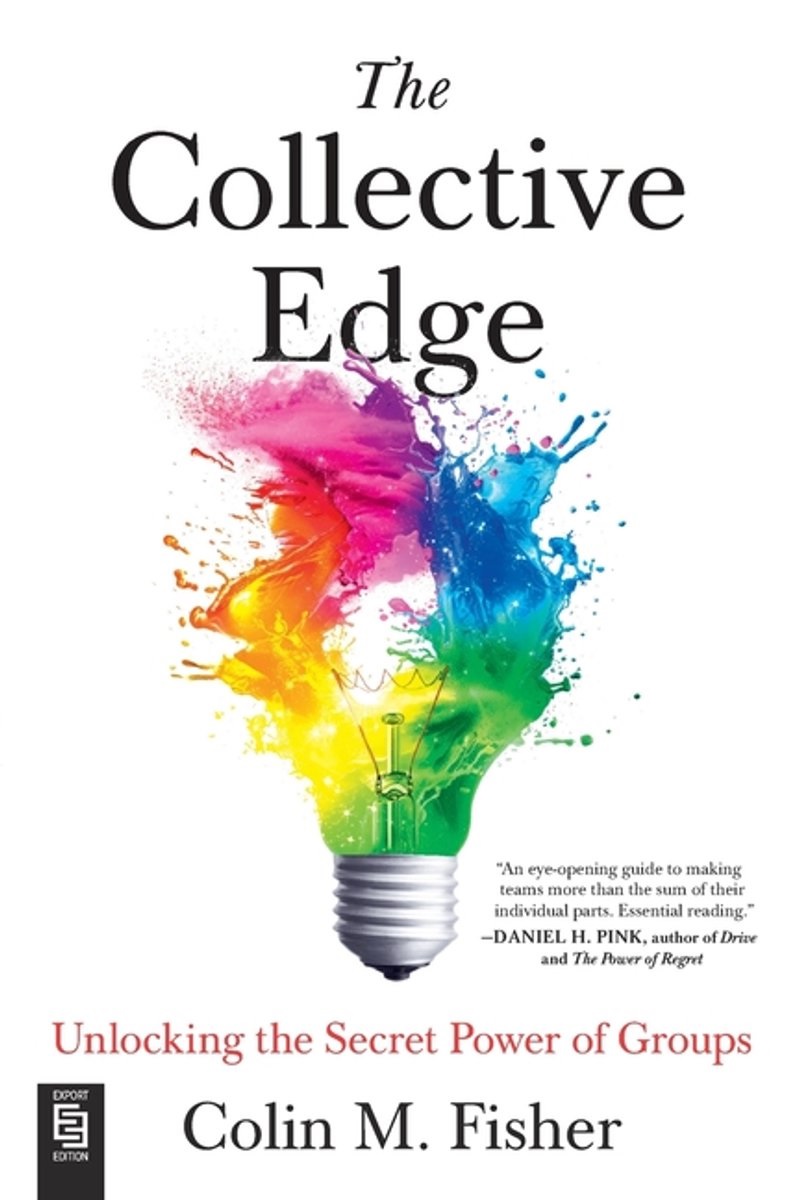
*) From Colin M. Fisher, The Collective Edge
‘'The power of the collective" is the principle that groups of people, through collaboration and shared goals, can achieve far more than individuals. This leads to better solutions to complex problems, stronger social cohesion, and innovation in organizations and societies, by leveraging collective wisdom and efforts. It revolves around a shift from individualism to connectedness, where people collaborate on shared interests, such as in societal transitions, the labor market, and in teams.
Group structure is essential for group dynamics.
The problems generally mentioned for a team's dysfunction are often symptoms. There's a tendency to immediately start coaching the team. But without a deeper analysis, this often turns out to be just treating the symptoms. Perhaps a short-term solution, but not for the underlying problems.
The most common mistake is blaming the causes of collective misperformance to individuals. People think the problems are caused by that one "rotten apple" who needs closer attention, or by that poorly motivated employee who needs a pep talk. Good coaching can lead to short-term changes, but poor structure has a lasting impact on processes that even the best coaching can't address.
Richard Hackman and Ruth Wageman used the so-called 60-30-10 rule to think about what has the greatest influence on group effectiveness.
[1] Ruth Wageman en Christer Lowe, ‘Designing, Launching and Coaching Teams’ The 60-30-10 Rule and its Implications for Team Coaching’ in The Practitioner’s Handbook for Team Coaching.
[2] Ruth Wageman, Colin M.Fisher en J.Richard Hackman, ‘Leading Teams When the Time is Right: Finding the Best Moments to Act’, Organisational Dynamics 38 (2009)
The rule states that 60% of group effectiveness is determined by structural characteristics: goals, tasks, composition, and norms. These structural characteristics are often established before the team's first meeting. Therefore, the best time for an intervention in this area is before the team begins work. Sometimes even before the group exists.
30% of the team's effectiveness is determined by how it's launched. Are the goals and mission clearly formulated? Do all members feel there's a good reason for being in the group; that they are accepted and respected for their potential contributions? Are the norms around psychological safety, good communication, and collaborative processes clear to everyone from the outset? Do all members feel they know what to do? Interventions in these areas can't be implemented early enough.
The remaining 10 percent is determined by skilled coaching, small adjustments, advice, and contributions to problem-solving to keep the team on track. If the structure is sound, processes and people will take care of themselves. They just need an occasional nudge in the right direction. Teams with a good structure can benefit from the encouragement, advice, and feedback that good coaching provides. Therefore, good coaching is the final necessary condition for team effectiveness, the icing on the cake of the collective perspective.
Team Design with the LD-Toolbox

In addition to accelerating the personal development of individual participants, the LD-Toolbox has a number of modules for putting together 'complete teams' and supporting teams in growing and becoming more effective.
In the development of these positions, we have been inspired by Richard Hackman, Colin Fisher, Manfred Kets de Vries and Patrick Lencioni, among others, and we have collaborated with the University of Maastricht (Prof. Robert Roe, Marielle Heijltjes, now Dean UM and with Anneloes Raes, then a student, now professor at IESE Barcelona). Our software is linked to a number of well-known models: Hofstede, Würsten, Belbin, Litman and for our SBTA (strategic Behavioural Traits Analysis) we have co-operated closely on strategic paradoxes with prof. Bob de Wit (Nijenrode) and Prof. Ron Meyer (Antwerp and Tilburg).
On the larger website LD-Toolbox.com, the various theories are discussed in detail.
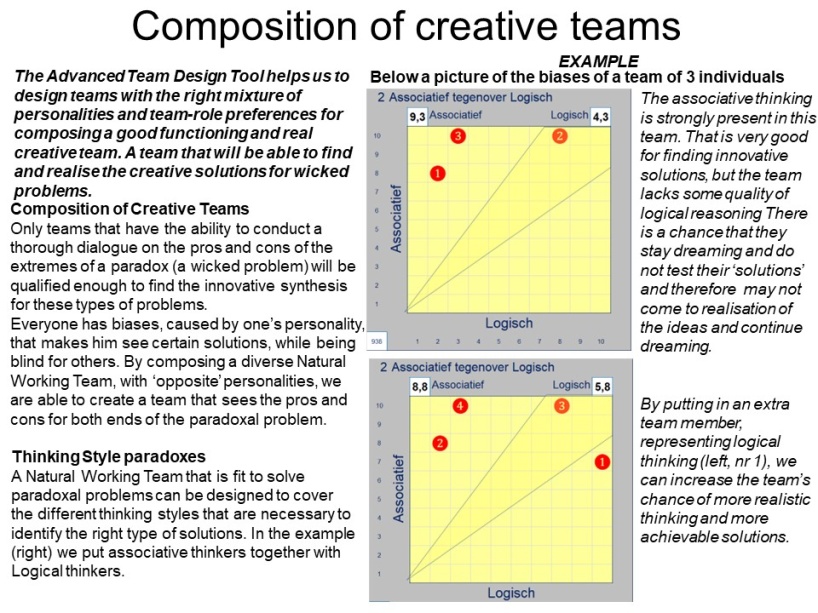
The Advanced Team Design Tool, facilitates the composition of 'complete teams' and the Team Effectiviness program helps teams, with a number of one-day workshops, to become more effective.
Corporate Profile Database or Regional Profile Database
As soon as we talk about team design and team development, it is often necessary to combine the data of several people.
To this end, we create a file in which the profiles of the people involved are stored.
For the companies where there are different services regarding people, teams and sometimes even the entire organization, such a file is called a Corporate Profile Database. Sometimes there is even a regional profile database, as with the ORIGINAL program.
Complete Effective Teams and Team Effectiveness
 Team Analysis Larry & Peters Company
With the stories of Nancy King, Rodney Duncan, Tessa Gold and Freddy Moss (under ORIGINAL Future Perspective) we have hopefully shown the reader that the LD-Toolbox is a credible tool for (accelerating) the personal development of the individual participant.
But we have not yet demonstrated that the LDT can also provide relief for the most important problem of innovators.
The issue that all (subsidy-using) service providers did not know how to address. The ORIGINAL program is in the process of setting up a Regional Innovators Profile Database.
The LD-Toolbox is also a tool with which we can design complete teams. Which we describe with the three stories below.
By clicking on the relevant pdf you can download the stories.
Here are three stories with which we show parts of the other functionality of the LD-Toolbox:
Larry and Peter's story is about a successful startup that needs to grow, attracting a number of new members to the MT.
The story of applicants at Business Consulting Netherlands is about selecting people for a number of vacancies.

- Larry en Peter English.pdf 1.4 MB
- New consultants for BCN.pdf 620 KB
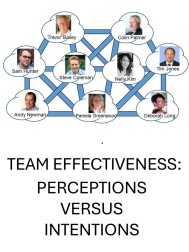
And the last story is about the first workshop of the Team Effectiveness Program.
It's about Internal Effectiveness, the mutual interaction between the individual members of a team.
If you want to know more about the entire Team Effectiveness program, you can click on the team image above. Then the relevant page of the large website LD-Toolbox.com opens in a separate page.
Advanced Team Design


Workgroups for strategic management
Continuous growth and change of the organization requires alert involvement of the entire management team
 Ralph D Stacey, Strategic Management & Organisational Dynamics
The leadership of an organization has to manage various processes:
- 'Ordinary Management' involves the day-to-day 'running' of the company's operational activities; For the highest management, this mainly means determining the goals and plans, and for the entire management team, the implementation of these goals and solving the problems and issues that arise.
- 'Extra-Ordinary Management' includes monitoring the company in its context, analysing changes in the market and its relationship with stakeholders, but above all developing a strategic course, taking greater steps in the development of the company, such as acquisitions, mergers, internationalisation and new branches of service. And, of course, integrating these changes into Ordinary Management.
- And, of course, manage the Projects and Programs, necessary for realising the bigger development steps.

In the YoCoComp Case Study, the need for internationalization, after a number of failures, becomes an urgent reason for a larger consulting organization to set up a standing organizational structure for strategic management. 'Extra-Ordinary Management' is led by a Policy & Strategy Board and 3 strategy working groups, with specially selected operational leaders. Click on the YoCoComp logo
to download a presentation about this case
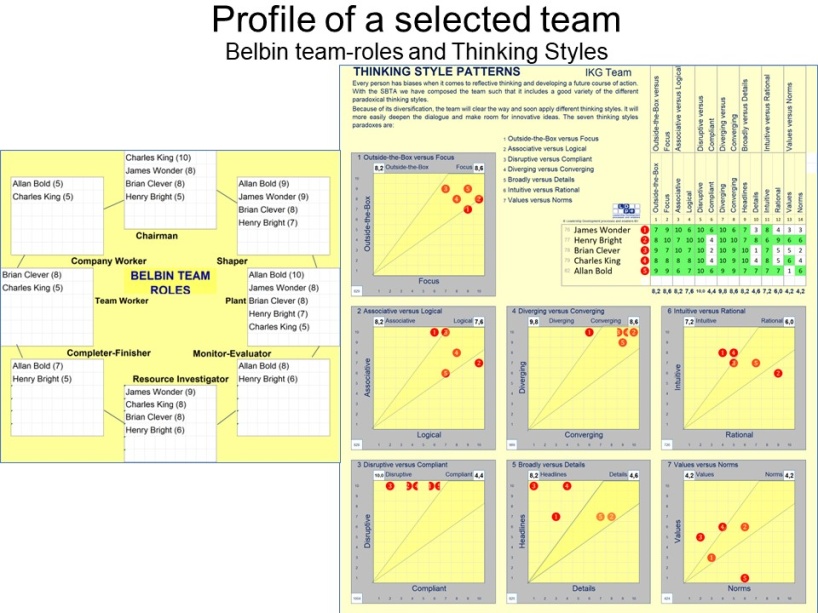
An important effect of this approach is the high involvement of all members of the management group, in the growth and development of the company. By putting together 3 working teama, based on their qualities and biases, each participant can contribute optimally and a solid foundation is laid for the strategic development of the company. In the meantime, the company remains on course and the high professionalism of its services is maintained. Moreover, through their involvement, managers will justify the major development steps to the employees and shine because of their strong motivation.